The cost split
I have been a long time Claude Code subscriber despite all the drama around Anthropic and how expensive Claude Code is with the harness being extremely token hungry and the models being super expensive. I had upgraded to a Max 5x subscription around May earlier this year and then around June I upgraded to Max 20x. It does sound insane when you think about paying $200 per subscription, but I have to say, the integration that they have done with their harness is absolutely smooth. I integrated the thing in all parts of my life. Schedules to read and sort my mails, build all my projects, managed my finances, everything being routed to Claude Code and life was chill.
But man, every time I upgraded, I could feel the current limit getting exhausted quickly despite the fact that they were already running an increased promotional period of extra limits. I got used to all this and then Fable class models were absolute token demolishers, gobbling usage limits like anything. Once I even ended up exhausting my whole week's budget in one night when using Fable 5.1 Ultracode in the name of experiment, where the agent just ran 150 other Fable agents.
Finally the hammer dropped, and Claude announced that they were reducing the limits.[1]
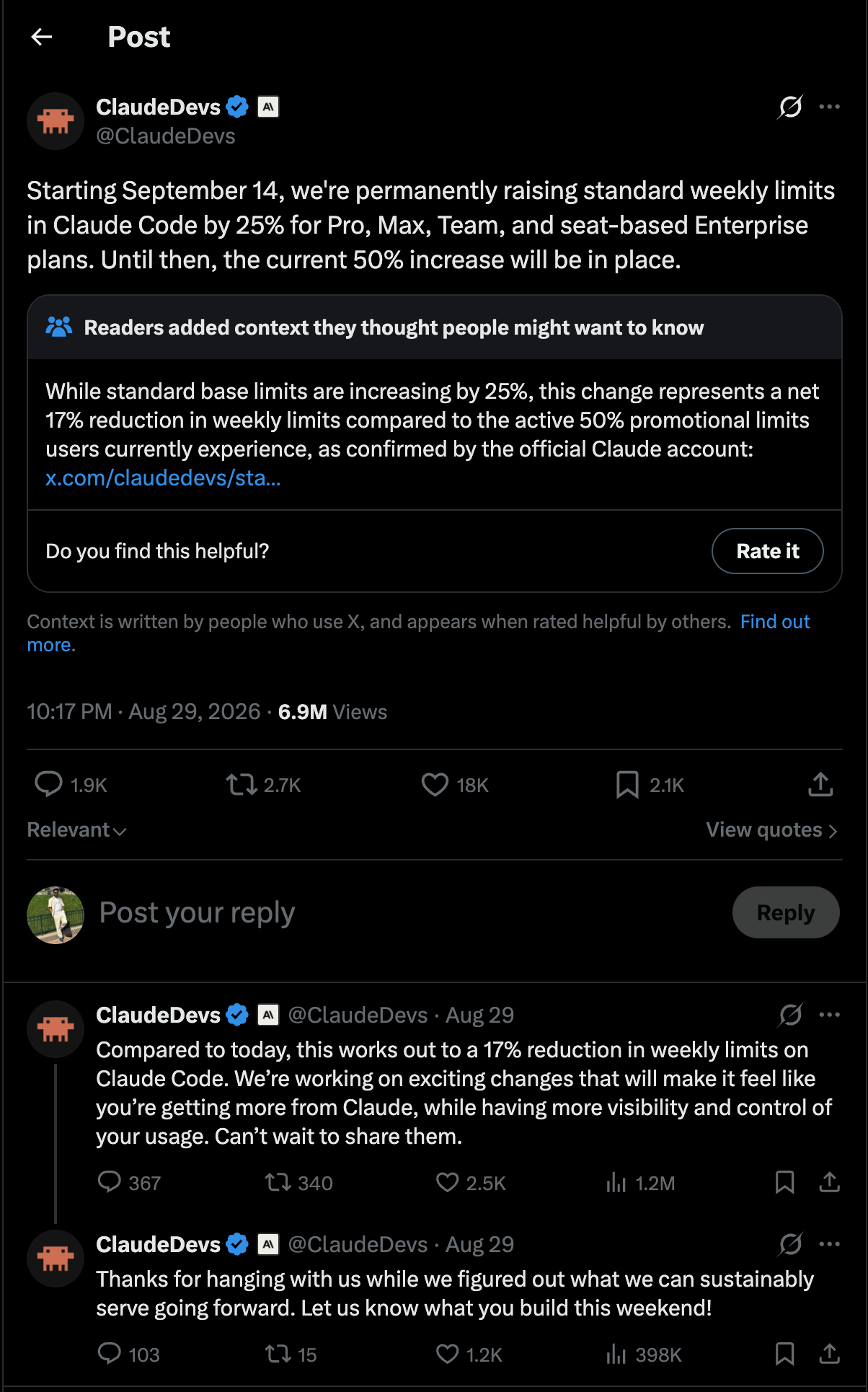
The headline says limits go up 25%, but compared to the 50% promo we were all on, it is a 17% cut, and ClaudeDevs said as much in the replies.[1]
Soon after this GPT-6 Astra came out, and I could not stop myself from testing that out, so I dished out another $100 for OpenAI's Pro subscription.

And while the experience itself was insane, Astra just guzzles tokens. I exhausted my whole limit in 6 hours. Gods blessed us with a token refresh but the whole thing was rinse and repeat and then again limit exhausted in 6 hours.
This made me think, I had gone from a lowly $20 subscription to now spending $300 monthly, and then also the fact that I was spending roughly another $60 to $70, give or take, on other things like AWS, Cloudflare etc. monthly. I will go broke if I continue like this and something needs to be done about my expenditures.
The cheap models got good
Luckily, around the same time, quite a few good open models came out that sit near the Pareto frontier. When I say near the frontier, what I mean is the line on the Artificial Analysis cost chart, which plots how smart a model is (their Intelligence Index) against what it costs to run a task.[2]
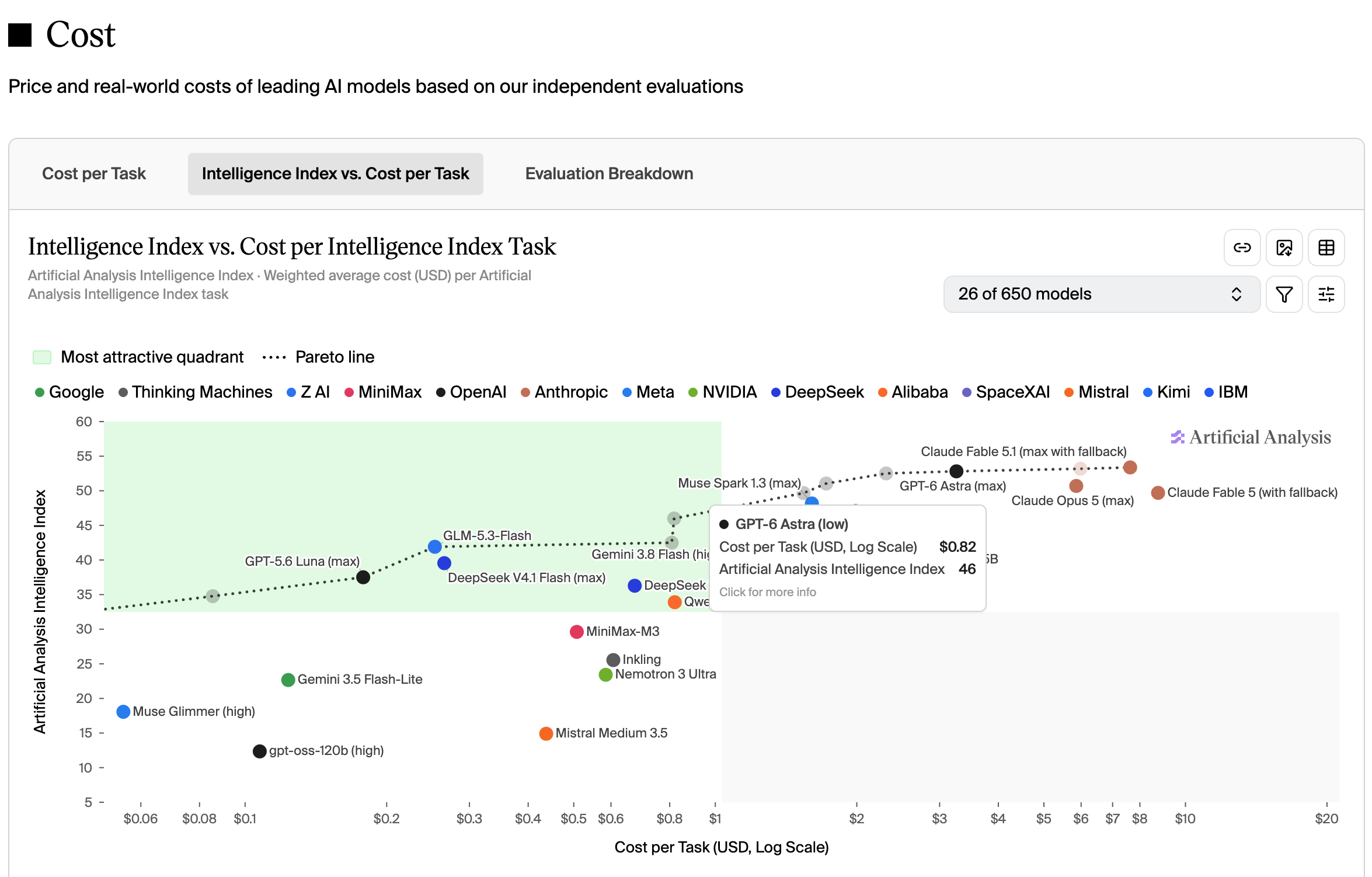
Muse Spark 1.3 from Meta and GLM 5.3 Flash from Z AI both sit right on that line, with DeepSeek V4.1 Flash just under it, almost as good as the frontier models at a fraction of the price.[2] My gut number was that in some cases I could save 30 to 40% of my costs.
So I did the math on the Zen price list, which I get to further down. Take a session that reads 50K tokens and writes 20K. On Claude Sonnet 5 that is $0.10 for the input and $0.20 for the output, so $0.30 in total. On GLM 5.3 it is $0.07 and about $0.09, so roughly $0.16, which is close to half. GLM 5.3 Flash, the one on the chart, comes to under 2 cents. Claude Fable 5.1 and GPT 6 Astra both come to $1.50 for the same session.[3] So per token, my 30 to 40% was on the low side. I think per task is a different question, because a model can use more tokens to reach the same answer, and that is what the cost per task chart tries to measure.
Trying them on Loom first
Back when my weekly Claude Code limits first started running out, I heard that a stealth model was free to use, with unlimited tokens, on both OpenCode and OpenRouter. I was building Loom then, my 24x7 researcher, and it reads a ton of sources, so I decided to learn how to plug these options into Loom and see how good they really were. I had 2 ways to go, either a harness like OpenCode, or direct API calls to OpenRouter through subagents from Claude Code and Codex, and for Loom I went with OpenRouter.
The first real pass ran on Sep 4, on a research thread about exactly this, harness costs. It planned 8 sources, and Gemma 4 26B read 6 of them through OpenRouter for $0.0019 in total, which is not a typo. The catch was quality. It pulled one usable digest out of a prose blog, and for a model listing, a README, a docs landing page and a model card it came back empty or wrong, so Sonnet read the 2 that failed the digest check again from the saved text and the pass still finished.
The experiments themselves did not prove that worthy, especially since the free model was getting rate limited most of the time. But they did push me to set up both OpenCode and OpenRouter.
Then DeepSeek dropped V4.1 Flash, and I looked at OpenCode properly. I did a lot of research on how its subscriptions work and settled on Zen, which right now has Muse Spark 1.3 for free. Once I tried Muse Spark 1.3 at the office and saw how good it was, I made it a point to use OpenCode permanently for the smaller tasks, like building repeatable skills in my toolbox repo, and HTML pages or artefacts.
How OpenCode Zen actually works
I spent a fair bit of time on this, so here is the short version.
OpenCode itself is free, it is an open source coding agent under the MIT licence and there is no monthly fee for the CLI.[4] To get models into it you have 2 options, bring your own API key from any provider and that provider bills you directly, or use Zen, which is OpenCode's own balance that bills per token with no markup on requests.[5][3]
Setting up Zen goes like this, you sign in to OpenCode Zen, add billing details, copy the API key, run /connect in the TUI, pick Zen, paste the key, and /models shows you the lineup. In config the models look like opencode/<model-id>, and after that Zen behaves like any other provider.[3]
Prices are per 1M tokens, with separate rates for input, output, cached reads and cached writes. These are the ones I care about, as of Sep 14 2026:[3]
| Model | Input | Output |
|---|---|---|
| Muse Spark 1.3 Contributor Free | free | free |
| DeepSeek V4 Flash | $0.14 | $0.28 |
| GLM 5.3 Flash | $0.15 | $0.50 |
| GPT 5.6 Luna, up to 272K tokens | $0.20 | $1.20 |
| Muse Spark 1.3 | $1.25 | $4.25 |
| GLM 5.3 | $1.40 | $4.40 |
| Claude Sonnet 5 | $2.00 | $10.00 |
| Claude Fable 5.1 | $10.00 | $50.00 |
| GPT 6 Astra, up to 272K tokens | $10.00 | $50.00 |
There is a catch with the free one. It is the Contributor Free version of Muse Spark, and in exchange for the price, your prompts and completions can be used to train future Meta models, which is worth knowing before you point it at private code. Free models also rotate, so one can disappear or turn paid, and it is worth checking /models on the day.[3] The GPT rows are the lower tier too. Past 272K tokens GPT 6 Astra goes up to $20 in and $75 out.[3]
On money, there is no quota wall on Zen, you just spend your balance. When the balance drops below $5 it auto-reloads $20, and you can change that amount or turn it off. With auto-reload off, the balance is a hard cap and the agent simply stops at zero. You can also set a monthly cap for the workspace and for each member, but with auto-reload on, charges can still go past that cap once the balance dips below $5. So an agent left running unattended with auto-reload on keeps spending, and you want to decide which behaviour you want before you walk away from it.[3] Card fees pass through at cost, 4.4% plus 30 cents, and nothing else gets added on top.[3]
There is also OpenCode Go, a flat $10 a month for the open models. Its limits are in dollars and set per model, so GLM 5.3 Flash gets $60 a month, which works out to $12 per 5 hours and $30 a week, while GLM 5.3 only gets $15. When you hit a limit Go blocks you, though the free models keep working, and if you turn on Use balance in the console it falls back to your Zen balance instead.[6]
Where this is going
So now I am moving work off Claude Code wherever I can. In Atlas I have a constant worker pool that is shared across my repos, where each assignment gets a fixed plan, a worker claims it, and a coordinator keeps track of capacity, and that part is already merged. Right now those workers call models straight through OpenRouter, and the plan is for them to run on OpenCode only.
Claude Code and Codex still do the heavy lifting, the design and the complex work, and part of their job now is breaking that work into finer tasks for the workers to pick up. The workers can also take over routine background stuff, like updating docs.
All of this is costing me a lot of time, building the ecosystem around the harness. Browser use, and quite a few other things I got used to and now expect from Claude Code, are not there yet on OpenCode. There is a lot of gap still, but the hope is I can mix the two, frontier for the bits that need it and OpenCode for the rest.
Sources
- [1]ClaudeDevs, Claude Code weekly limits — permanent 25% rise, net 17% cut from the promox.com29 Aug 2026↩ back
- [2]Artificial Analysis cost page — Intelligence Index vs cost per taskartificialanalysis.ai14 Sep 2026↩ back
- [3]OpenCode Zen docs — setup, pricing, auto-reload, privacyopencode.ai14 Sep 2026↩ back
- [4]anomalyco, opencode — The open source coding agent (MIT License)github.com14 Sep 2026↩ back
- [5]OpenCode homepage — free models included or connect any modelopencode.ai14 Sep 2026↩ back
- [6]OpenCode Go docs — price, model list, usage limits, Zen balance fallbackopencode.ai14 Sep 2026↩ back
- OpenCode Intro docs — any provider via API keys, /connectopencode.ai14 Sep 2026